
Follow our social community |


Statistical modeling and genomics to enhance livestock breeding in Africa
- Details
- Written on Saturday, 01 July 2017 17:16
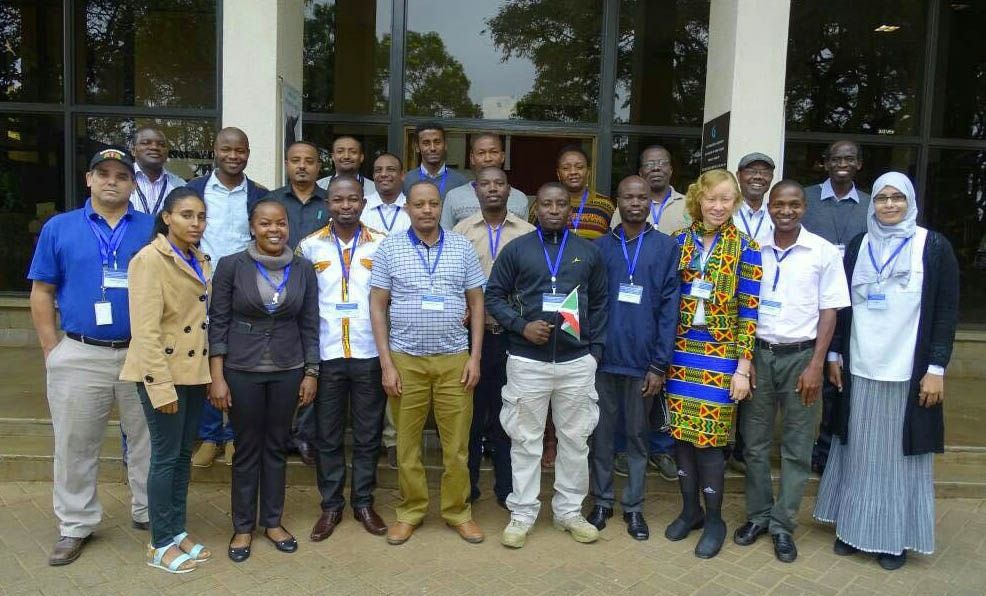
Participants of the BecA-ILRI Hub's 2017 Animal Quantitative Genetics and Genomics workshop pose with the trainers Romdhane Rekaya (left), Raphael Mrode (back row right) and Sammy Aggrey (back row second right). (photo: BecA-ILRI Hub/Brian Otieno)
June 30, 2017 marked the final day of the Animal Quantitative Genetics and Genomics training held by the Biosciences eastern and central Africa-International Livestock Research Institute (BecA-ILRI) Hub in Nairobi. The workshop was held as one of the BecA-ILRI Hub’s Africa Biosciences Challenge Fund (ABCF) program annual trainings in key skill areas.
The increasing demand for animal protein in emerging economies in Africa presents opportunities to sustainably improve livestock productivity. A better understanding of quantitative genetics—the basis of traits controlled by multiple genes in livestock—underpins the development of more successful livestock breeding programs that could accelerate animal protein production and move Africa towards food security.
For 10 days, 21scientists from national agricultural research systems (NARS) of 14 African countries—Benin, Burkina Faso, Burundi, Cameroon, Chad, Democratic Republic of Congo, Ethiopia, Ghana, Kenya, Nigeria, Rwanda, Somalia, Sudan and Tanzania—participated in the course that gave them skills to support their research in livestock improvement including: population and quantitative genetics, linear models, variance components, selection principles, breeding strategies, genome selection and implementation of statistical tools in animal breeding.
Researcher Salome Shayo from Tanzania Fisheries Research Institute acknowledged the relevance of the workshop to fish breeding programs in Tanzania. Shayo is involved in research to improve the growth rate, survival, age at maturity, and carcass quality of tilapia fish, which will be produced by smallholder farmers in the country.
‘The knowledge I gained from the workshop has enabled me design a selective breeding program for improvement of tilapia production in Tanzania,’ said Shayo, who plans to start the breeding process with wild stock selected for genetic variation and heritability of traits of interest.
Echoing Shayo’s sentiments, tutorial fellow Sophie Miyumo from Egerton University in Kenya commented:
‘Attending this workshop gave me clarity in my proposal for research on indigenous chicken which I intend to carry out through the ABCF fellowship program.’
Julius Hagan, a senior lecturer from the University of Cape-Coast in Ghana requested that the workshop be offered to an even broader pool of scientists as he considered the training to be beneficial and needed by so many African countries.
The workshop was facilitated by: Raphael Mrode, ILRI principal scientist and professor in quantitative genetics and genomics at the Scotland Rural College; Samuel E. Aggrey, professor at University of Georgia’s Department of Poultry Science and Institute of Bioinformatics; and Romdhane Rekaya, professor at the University of Georgia’s Department of Animal and Dairy Science and Institute of Bioinformatics. The trainers are among BecA-ILRI Hub’s extended faculty comprising affiliated scientists drawn from institutions across the globe, which enables a broader scope of scientific advice, supervision and training through the ABCF program
Comments
- No comments found


Recent News View all News
-
BecA-ILRI Hub biennial report 2018-19
- Tuesday 14th July 2020
-
ABCF 2020 - Call for applications
- Saturday 14th December 2019
-
Brachiaria Grass is introduced to Masindi, Uganda
- Thursday 18th October 2018
-
Reducing Toxicity of Grass Pea
- Friday 28th September 2018
Leave your comments